
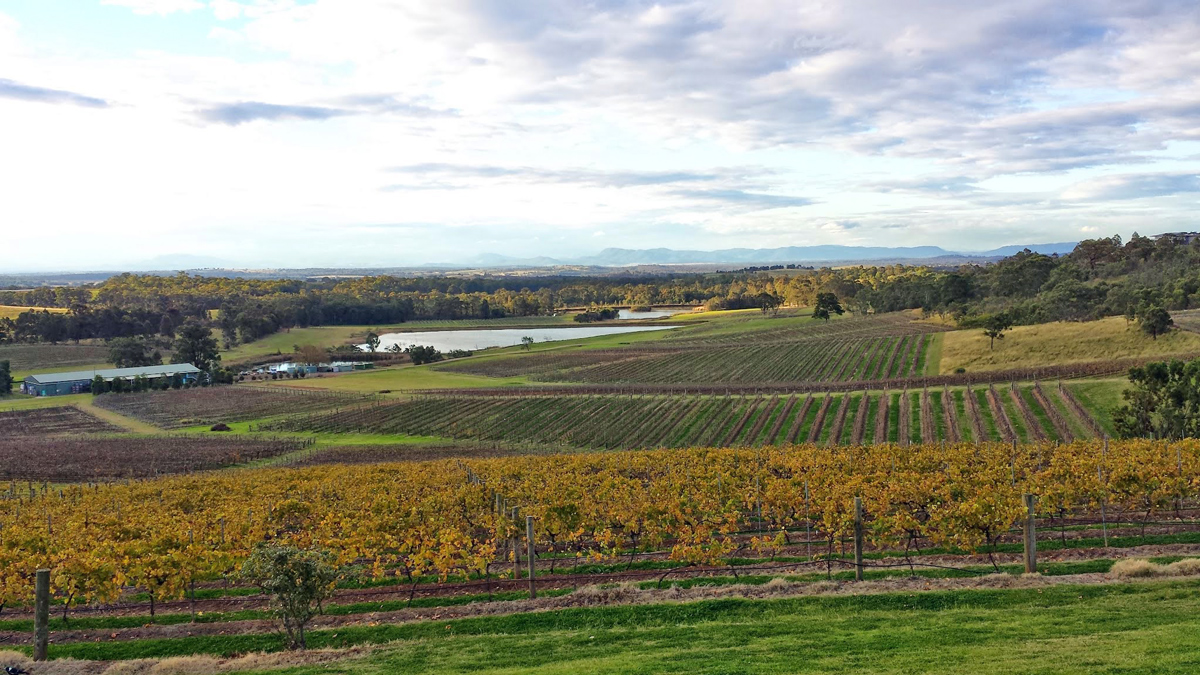
Australia’s oldest wine region, two hours north of Sydney, on your own wheels. The guide names what each winery actually makes — who pours reds, who pours whites, and the one house in the valley that makes nothing but sparkling — so you know before the turn-off whether to stop.
Between the cellar doors it tells you the rest: the bridges and wildlife parks on the way up, the coal towns that built the district, a convict road cut by hand, a gaol that ran for a hundred and fifty years, and a river port that stopped in 1870 and never changed. No route to follow: drive as you please and each story begins as you arrive.
Every place on the map
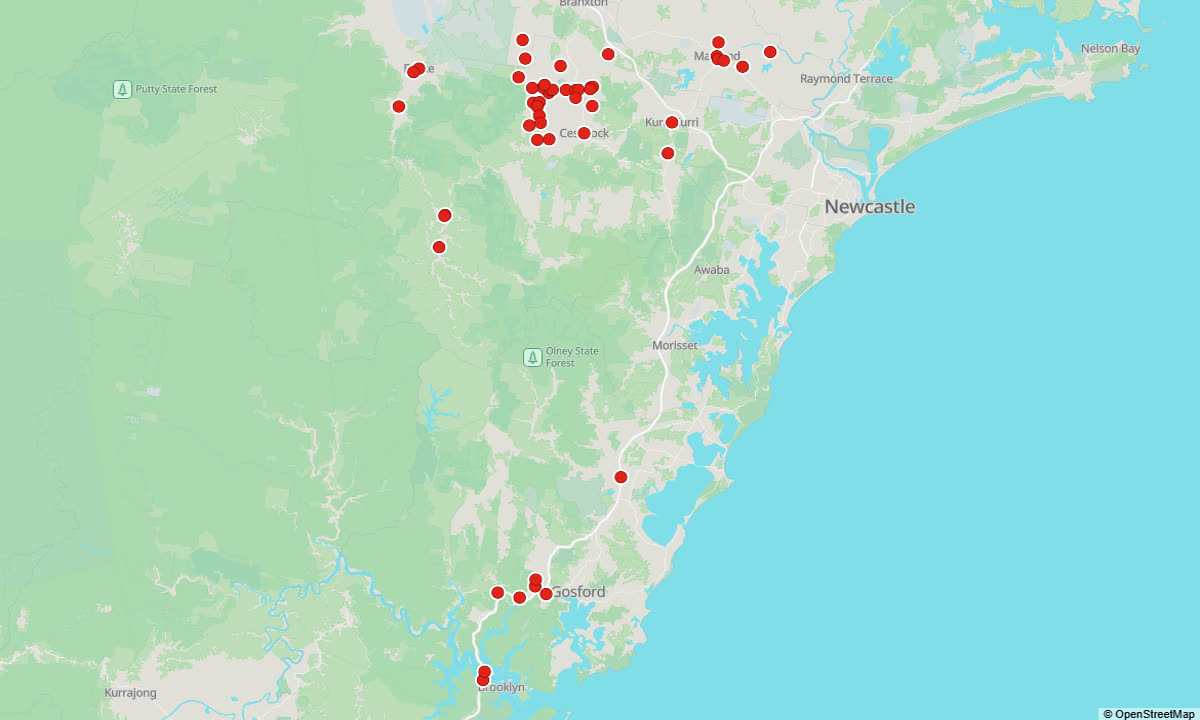
Each red dot is a place with its own story. The story starts by itself when you reach it — on foot, by bike or by car.
All 51 places in this guide
Here is every place the guide tells you about, with the first line of its story:
- Hawkesbury River Bridge (Peats Ferry Bridge) — The Hawkesbury River. For a century this was the place where the road to the north simply stopped.
- Hawkesbury River Oyster Shed — The oyster leases of the Hawkesbury. Those lines of stakes and racks in the shallows are farms, and some of them have been worked by the same families for four generations.
- Mooney Mooney Creek Bridge — Seventy-five metres above the water, four hundred and eighty metres long, and the tallest bridge in New South Wales when it opened in December 1986.
- Walkabout Wildlife Sanctuary, Calga — Walkabout Wildlife Sanctuary at Calga. Two hundred hectares of bush, and the animals in it are not in enclosures.
- Mount Penang Gardens, Kariong — Mount Penang. Today it is a public garden, thirty hectares of landscaped grounds, sculpture and open lawn where the Central Coast holds its concerts and its markets.
- Australian Reptile Park — If you or anyone you know is ever bitten by a funnel-web spider in this country, the antivenom that saves your life will have started here.
- Somersby Falls — Two waterfalls, one above the other, dropping through rainforest in a gully that the surrounding plateau gives no hint of.
- Wyong Milk Factory — It began in 1907 as a butter factory, built by a co-operative of fifty-six local dairy farmers who were tired of selling their cream to somebody else's profit.
- Kurri Kurri Murals — Kurri Kurri. More than sixty painted murals on the walls of this town, and they are not decoration.
- Cessnock — The vineyards are ten minutes away, and almost nobody who comes for them thinks about this town, which is a pity, because it explains the whole valley.
- Hunter Valley Gardens — Fourteen hectares of formal garden in the middle of a wine district, and the one place in Pokolbin built for the people in the car who do not drink.
- Pokolbin Village — Pokolbin. Look for the town and you will not find one. There is no main street here, no post office, no school.
- Harrigan's Irish Pub — Harrigan's. After a day of cellar doors, this is where the Hunter Valley ends up.
- Tyrrell's Wines — Tyrrell's. Edward Tyrrell took up three hundred and twenty acres here in 1858 and built himself a hut of ironbark slabs.
- Brokenwood Wines — Brokenwood. In 1970, three Sydney lawyers bought four hectares of unloved land here as a weekend project.
- Tempus Two — Copper, concrete and glass, and the building is either the most striking thing on Broke Road or a shopping centre with vines outside, depending on who you ask.
- Hungerford Hill — The building is the one you cannot miss on Broke Road, a long sweep of glass and timber that looks like it was poured rather than built, and it divides opinion in a valley where almost everything else is a shed with a…
- Audrey Wilkinson Vineyard — Audrey Wilkinson. The vines here went in in 1866, which makes this one of the oldest vineyard sites in the Hunter, and the view from the cellar door is the one every photograph of this valley is taken from.
- Tulloch Wines — Tulloch. The family got into wine by accident in 1895.
- Ben Ean — The estate dates from 1858. The Lindeman family bought it in 1917, put their name in front of it, and for most of the twentieth century this was the best-known winery address in New South Wales.
- Drayton's Family Wines — Drayton's. Joseph Drayton came to this country in 1853, took up land at Bellevue, and planted vines.
- Mount Pleasant Wines — Mount Pleasant. This is where Maurice O'Shea worked, and if Australian red wine has a founding figure, it is him.
- Briar Ridge Vineyard — Briar Ridge. You have left the flat here and started climbing, and that is the whole point of this winery.
- Mount View lookout — Mount View. You are on the high ground now, looking back across the whole of Pokolbin, and this is the view that explains the valley better than any map.
- Mount Bright Lookout — You are on the top of the ridge, on the highest ground anyone drives to from Pokolbin, and the whole wine district is laid out below you.
- Oakvale Wines — Oakvale. An old Hunter name in a small building on Broke Road, and one of the few cellar doors in the valley where everything poured is organic and every wine is vegan.
- Keith Tulloch Wine — Keith Tulloch. The surname belongs to one of the oldest wine families in this valley, and this is not that winery.
- Piggs Peake Winery — Piggs Peake. Every wine here is named after a pig, and the labels are drawn accordingly.
- Bimbadgen Estate — Bimbadgen. The bell tower on the hill is the one building in this valley you can navigate by.
- Hunter Valley Chocolate Company — A working chocolate factory with a window into it, which is the correct way to sell chocolate, and the reason this is the busiest non-winery stop on Broke Road.
- Peterson House — This is the one address in the Hunter Valley that makes nothing but sparkling wine.
- De Bortoli Wines, Hunter Valley — De Bortoli. The family is not from here. Vittorio De Bortoli arrived from northern Italy in the 1920s and started making wine at Griffith, out on the irrigated plains of the Riverina, four hundred kilometres west of this valley.
- Hunter Valley Wildlife Park — Koalas, kangaroos, wombats, dingoes, reptiles and birds, on a property at the edge of the vineyards, and it exists for a very practical reason: the Hunter is full of people who have flown a long way to see…
- Hunter Valley Airport — A single strip in the middle of the vineyards, and what happens here is the two ways of seeing this valley that do not involve a car.
- Adina Vineyard & Olive Grove — Adina. A small family vineyard at Lovedale with an olive grove beside it, which is a more sensible combination than it sounds, because both crops want the same thing: heat, poor soil and no interest in being watered.
- Binnorie Dairy — A small cheese room in the middle of the vineyards, and the reason half the restaurants in this valley have the same cheese on the board.
- Lovedale — You have crossed out of Pokolbin, and the first thing you notice is that the traffic has gone.
- Wandin Estate — A vineyard at Lovedale with a restaurant, villas, a lot of resident kangaroos and, for no reason that has ever been properly explained, its own cricket oval.
- Richmond Vale Railway Museum — Richmond Vale. This was Richmond Main, and when it was finished in 1913 it was said to be the most modern colliery in the southern hemisphere.
- Broke Village — Broke. A village of a few hundred people on Wollombi Brook, with a general store, a pub, a church and a war memorial, and it looks almost exactly as it did seventy years ago.
- Margan Wines — Margan. If you eat one meal in the Hunter Valley, a lot of people will tell you to eat it here, and the reason is not the chef.
- Krinklewood Vineyard — Krinklewood. A French-looking house and garden on the bank of Wollombi Brook with the Brokenback Range standing behind it, and the most rigorously farmed vineyard in the Hunter Valley.
- Wollombi Village — Wollombi. A handful of sandstone buildings at a crossing of creeks, a church, a museum, a pub, and a population you could fit in a bus.
- Wollombi Tavern — On a Sunday this car park holds more motorcycles than the rest of the district put together, and there is a reason that has nothing to do with the road.
- Great North Road convict works — The Great North Road. What you are on, or beside, is one of the largest engineering works ever built in Australia by hand, and it was built by men in chains.
- Maitland Gaol — It opened in 1848 and it closed in 1998, which makes a hundred and fifty years of continuous operation, the longest of any gaol in Australia.
- Maitland Heritage Mall — High Street, Maitland. One of the most complete Victorian streetscapes in Australia: two-storey shopfronts with iron lace verandas, banks built like temples, and a curve to the street that follows the old track along the river.
- Grossmann House — A two-storey Georgian townhouse in brick, built in 1870 for a Maitland merchant, and one of a matching pair: the house next door was put up at the same time, to the same design, for his business partner.
- Maitland Regional Art Gallery — One of the largest regional galleries in New South Wales, in a town of eighty thousand people, and it is a serious institution rather than a room with local watercolours.
- Walka Water Works — A Victorian pumping station beside a lake, and one of the more unexpected buildings in the Hunter: red brick, arched windows, a tall chimney, put up in the 1880s to a standard of decoration that a pumping…
- Morpeth Village — Morpeth. This little town of antique shops and tea rooms was, for about forty years, the most important port in northern New South Wales.
Between the places: podcasts
The guide does not fall silent between the places. In the gaps it plays podcasts about Australia — more than 14 hours in this guide: the history of the city and the country, the people, the animals and nature, and life in Australia today. You can listen to them on their own too, before the trip or on the way.
Get the full guide
Access is sold by time, not by tour. One pass opens every guide we have — Sydney, the Sydney Light Rail, the Blue Mountains, the Hunter Valley, Melbourne, the City Circle tram, the Great Ocean Road and the Dandenongs with the Yarra Valley — in English and in Russian. The time starts when you first open your link.
↓ Tap a price to pay — every pass opens every guide
Secure payment via Square • card, Apple Pay and Google Pay
Free without signing up: the map, 5 places and 5 minutes of the podcast. The full audio unlocks from A$35.
Runs in the browser of your phone, nothing to install. For playing with the screen off there is the app: App Store · Google Play.
Other guides
By Andrew Sorokin, Sydney guide since 2006.